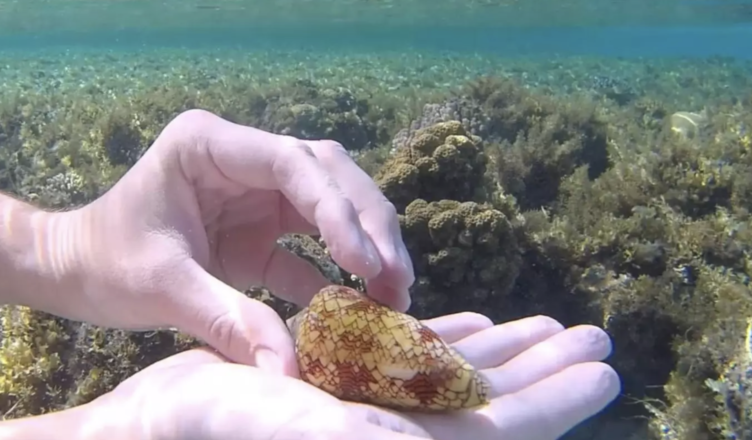
People are commenting on an underwater shot, noting how ‘foolish’ but yet exceedingly ‘fortunate’ a Reddit member is.
If I asked you to make a list of creatures you’d prefer not to see when paddling in the water, you’d probably pick sharks, octopuses, and sea snakes, but there’s one species you’ve never heard of or seen before that you might maybe dread even more.
Last month, Reddit user u/AArdvarkPaws posted a photo from their trip to Egypt’s Red Sea on the r/animalid thread.
The picture depicts a pair of hands underwater, one of which looks to be clutching a shell in its palm.
The user claimed to have taken the shot with an underwater GoPro “a while back.”
“I thought I just found a very pretty seashell and was thinking about taking it home as a souvenir, but I noticed it’s still alive, feeling some weight and movement inside, so I decided to at least take some pictures of it,” they told me.
They continued, “Only months later, I was warned that managing it in this manner could have been a very terrible choice. Could you please assist me in identifying what it was and what type of danger I was actually in? Was there an actual danger to my life?”
The post asks, “How lucky am I to still be alive?”
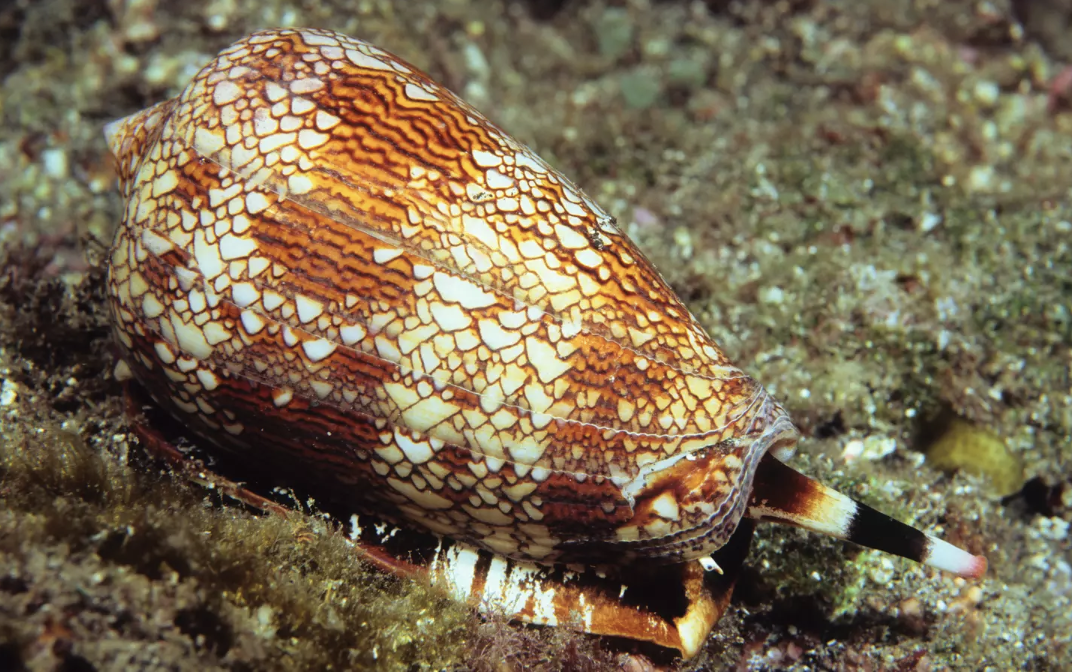
Social media users quickly flocked to the picture, expressing their gratitude for the individual’s survival, especially considering they were holding a textile cone snail instead of a shell.
A user said, “Are you insane?!”
“You’re lucky and foolish,” a second person said.
A third added, “Dodged a nuke.”
Another user provided some useful information: “This is a textile cone snail, Conus textile.” All cone snails are poisonous, and this particular species is known to be hazardous to people.
Indeed, ‘dwelling on the sand beneath the coral and rocks in shallow seas,’ Aquarium of the Pacific describes cone snails as ‘one of the most venomous organisms on Earth.’.
“Among the most toxic are the textile, geographic, and tulip snails, and there is a higher risk of death if the geographic and textile snails are involved,” according to the report. “All capture their prey by means of harpoon-like hollow teeth (radula) that are rapidly jabbed into their prey to inject the toxic venom.”
How lucky I am to be still alive? [Red Sea, Egypt]
byu/AArdvarkPaws inanimalid
What about attacks on humans? Typically, these attacks occur when someone steps on or picks up a cone snail from the beach or ocean.
U/AArdvarkPaws stated that they were eventually focused on sharks, jellyfish,’ and other more evident species, and ‘didn’t consider for a minute about risk from this.’.
“I’ll never pick one up again,” they determined, but they wondered what would happen, medically speaking, if they were bitten by a cone snail.
According to the National Library of Medicine, the agony can range from ‘a strong pricking feeling to intolerable anguish,’ depending on the snail type and the sufferer.
The sting can cause local numbness or extend to ‘entire parts of the body,’ advancing from ‘initial weakness, sweating, and visual alterations to widespread muscular paralysis, respiratory failure, cardiovascular collapse, and coma.'”.
“If a patient is not treated, death happens rapidly, usually within one to five hours. It advises that less severe envenomations caused by interaction with molluscivore and vermivorous animals have lower harmful consequences.” These effects are also variable and may include numbness, paresthesias, and limb immobility.”
Basically, don’t pick up any cone-shaped shells from the ocean bed—or disturb anything else in the water, for that matter—but if you are stung by a cone snail, get to the hospital as quickly as possible.