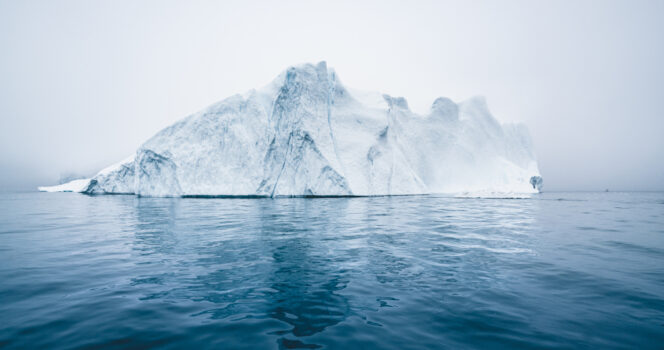
Three of the world’s most prominent cities might be drowned if Antarctica’s so-called “Doomsday Glacier” collapses, something experts believe is growing increasingly inevitable.
Climate change has long been associated with increasing sea levels, higher global temperatures, and extreme weather occurrences. However, a recent study on the Thwaites Glacier (ominously called the “Doomsday Glacier”) is bringing the potential implications into clearer, more worrisome focus, reports BBC Science Focus.
Thwaites Glacier, in West Antarctica, contains enough frozen water to raise world sea levels by more than 2 feet. Scientists fear that if it completely collapses, it might start a chain reaction that affects the much bigger Antarctic ice sheet. What was the result? The result was a startling 10-foot rise in sea level, sufficient to flood major global cities like London, New York, and Bangkok.
These cities, which are home to millions and popular with tourists, would be among the first to flood in such a situation.
Have you heard about the Thwaites Glacier, aka the Doomsday Glacier?
It’s melting rapidly, and scientists are warning that its collapse could mean global flooding and disaster.
Here’s what’s happening and how supply chains can adapt: pic.twitter.com/LR3iD7kbxn
— Glenn Koepke (@LogTech1999) December 23, 2024
Researchers, as part of the International Thwaites Glacier Collaboration (ITGC), have intensively monitored Thwaites in 2018 to examine its stability. What they discovered is highly concerning: the glacier is littered with so-called “hidden lakes” beneath its surface, which might play a significantly bigger role in its future collapse than previously assumed.
In March 2025, research conducted by Professor Noel Gourmelen, an ITGC member, demonstrated that these subglacial lakes are dramatically speeding ice melting.
“We expected that water draining from the underside of the ice sheet plays a role in modulating ocean melting,” according to Gourmelen. “The sheer size of this lake drainage allowed us to finally see and measure its impact.
“The lake overflow occurred in a critical area affecting Thwaites’ stability. The discharge effectively accelerated Thwaites’ ocean-driven retreat.”
That “turbo charge” comes at a time when the Southern Hemisphere is already experiencing higher-than-expected temperatures in 2025, raising concerns that the glacier may be melting quicker than projected.
Dr. Alastair Graham, a marine geologist at the University of South Florida and a member of the ITGC, told News.com.au that if Thwaites Glacier collapsed, sea levels would increase by about 65 cm (25 inches).
“This year is quite different. It is quite tough to recover from this in one season.” The game has changed.”
While the glacier’s entire collapse may still be decades (or even centuries) away, the most recent data suggests that the tipping point might occur far sooner than scientists had thought. And if it happens, the world’s coasts, economy, and millions of lives may be forever changed.