
The Myers-Briggs Type Indicator (MBTI) personality test has gained popularity in a world where knowing oneself and others can lead to greater success in both personal and professional spheres. Isabel Briggs Myers and her mother, Katharine Cook Briggs, created the MBTI to help people identify their personality type among 16 different categories. This knowledge can inform job decisions, strengthen relationships, and increase self-awareness.
What does the MBTI stand for?
Carl Jung’s idea of psychological types is the basis of the MBTI. Humans are divided into 16 different personality types based on four dichotomies:
The difference between extraversion (E) and introversion (I) relates to how people acquire energy. While introverts refuel by spending time alone, extraverts get their energy from social interaction.
Sensing (S) vs. Intuition (N): This dimension is concerned with how individuals interpret data. While intuitives tend to focus on possibilities and patterns, sensors rely on specific, factual information.
This pair, Thinking (T) vs. Feeling (F), describes how individuals arrive at decisions. While feelers take into account their own values and the effects their judgments will have on others, thinkers base their conclusions on reason and objective standards.
Judging (J) vs. Perceiving (P): This contrast draws attention to how one approaches organization and preparation. Perceivers are more adaptable and spontaneous than judges, who value a structured and planned way of living.
The MBTI determines a person’s preferred side of each dichotomy by having them respond to a series of questions. This produces a four-letter personality type (e.g., INFP, ESTJ).
The sixteen distinct personality types
Every one of the sixteen MBTI personality types presents a different combination of traits. Here’s a quick rundown:
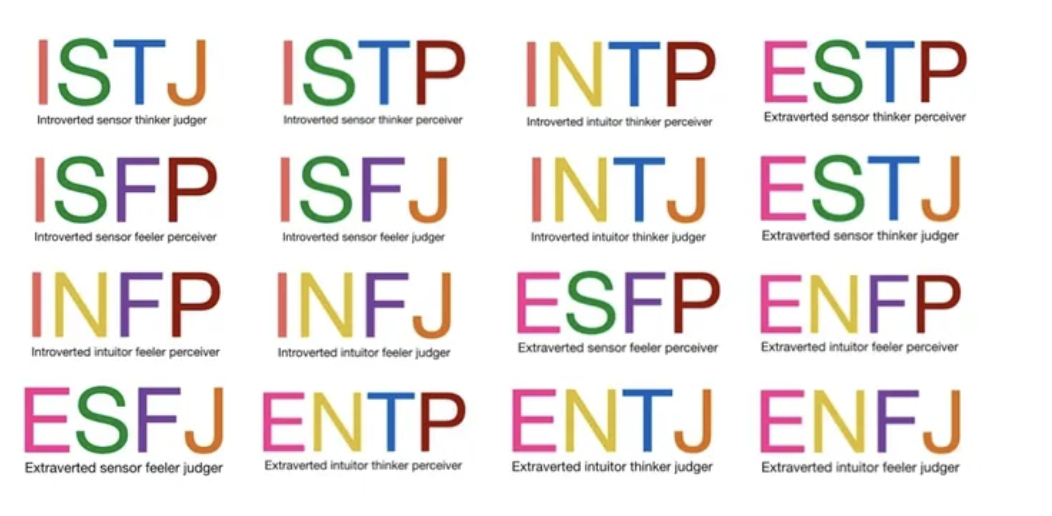
ISTJs, or “The Inspectors,” are pragmatic, fact-aware people who respect custom and hierarchy.
ISFJs (the protectors) are kind, devoted individuals who are always willing to stand up for those they love.
INFJs (the advocates) are idealistic, moral people with a high sense of self-discipline.
Architects, or INTJs, are strategic thinkers who are planning for everything.
ISTP (The Virtuoso): fearless and realistic experimenters, adept with a wide variety of instruments.
The versatile and endearing ISFP (the adventurer) personality type is always eager to learn and explore new things.
INFPs (the mediator) are gentle, empathetic, poetic, and always willing to lend a hand to a worthy cause.
INTPs, or “logicians,” are creative creators with a voracious need for information.
ESTPs (the entrepreneurs) are astute, gregarious, and insightful individuals who genuinely love living on the brink.
ESFP (The Entertainer) is an animated, gregarious, and passionate actor; life is never dull around them.
ENFPs (The Campaigners) are gregarious, creative, enthusiastic, and free spirits who never fail to make people smile.
ENTP (The Debater): People with sharp minds and a passion for intellectual debate.
ESTJ (the Executive): Outstanding managers who excel at overseeing tasks or personnel.
ESFJ (The Consul): exceptionally kind, gregarious, well-liked, and willing to lend a hand.
The protagonist, an ENFJ, is a charismatic and inspirational leader who has the ability to captivate an audience.
ENTJ (The Commander): Brave, resourceful, and self-assured leaders who never fail to find a way—or create one.
Why do the MBTI exams?
Knowing your MBTI personality type has several advantages.
Self-Awareness: Acquire an understanding of your preferences, shortcomings, and strengths.
Better Relationships: By identifying various personality types, you can relate to and comprehend others more effectively.
Career Advice: Determine which occupations best suit your innate abilities and preferences.
Personal Development: Using your personality insights.
How is the MBTI taken?
The MBTI is extensively accessible on the internet, with several sites providing both free and premium copies of the exam. Even though the official MBTI assessment yields the most accurate findings, there are still several free variants that can provide insightful information.
You will respond to a series of questions regarding your preferences and behaviors in order to take the MBTI. It usually takes 15 to 30 minutes to finish the test. You will receive your four-letter personality type and a detailed explanation of its traits after completing the assessment.
In summary
An effective tool for learning more about others, including oneself, is the MBTI personality test. You can develop a deeper degree of self-awareness, enhance your relationships, and make better decisions regarding your personal and professional life by knowing your MBTI type. Whether your goal is to advance professionally or personally, or you’re just interested in learning more about your personality, the MBTI can provide insightful information to help you along the way.