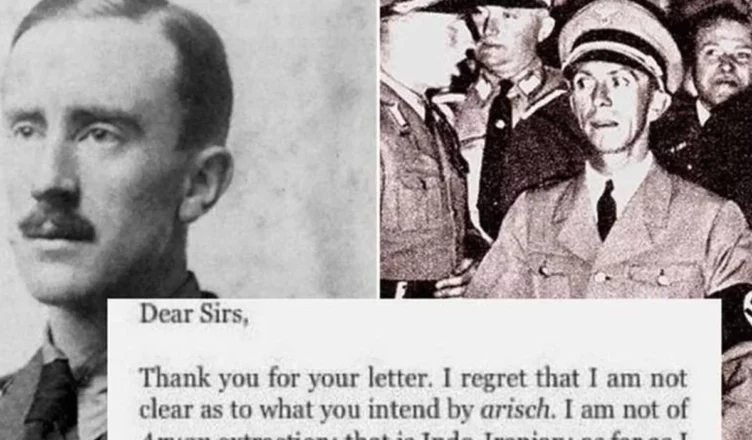
In 1933, Adolf Hitler delegated control of Jewish cultural life in Nazi Germany to Joseph Goebbels, his top propagandist. Goebbels formed a group of regulators to monitor the works of Jewish artists in film, theater, music, fine arts, literature, radio, and journalism.
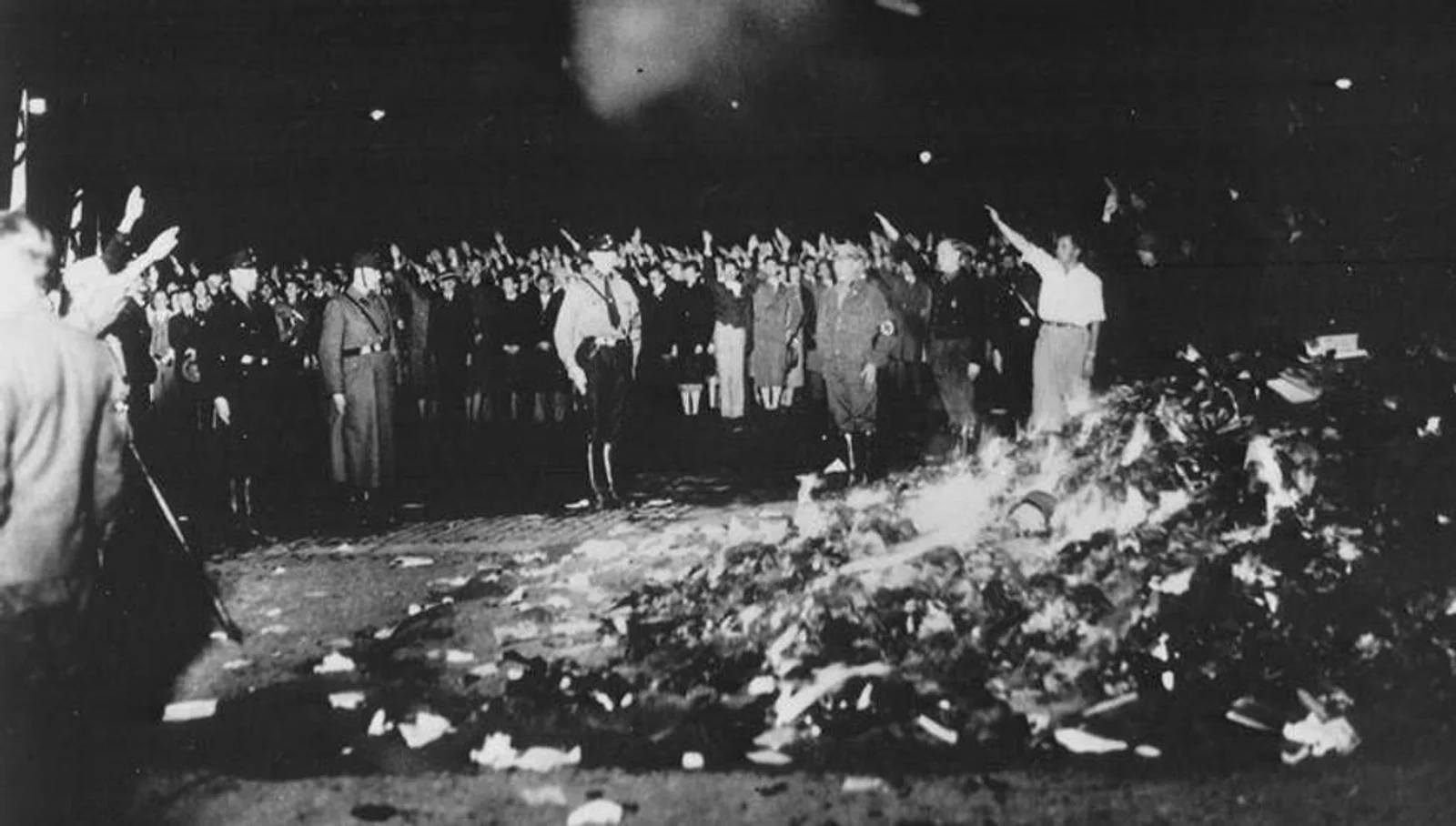
Goebbels’ new laws effectively banned Jewish people from engaging in mainstream German cultural events by forcing them to get a license.
The Nazis’ desire to purify Germany of all cultures that were not Aryan in origin resulted in the questioning of artists from outside the country.
In 1938, English author J. R. R. Tolkien and his British publisher, Stanley Unwin, began negotiations with Rütten & Loening, a Berlin-based publishing business, concerning a German translation of his newly released smash novel, “The Hobbit.”
According to “1937 The Hobbit or There and Back Again,” Tolkien privately criticized Nazi “race-doctrine” as “wholly pernicious and unscientific.” He noted that he had many Jewish acquaintances and was considering abandoning the notion of a German translation entirely.
Tolkien received a letter from the Berlin-based publishing firm, requesting evidence of his Aryan origin. Tolkien was enraged by the request and responded to his publisher in two ways: one by avoiding the topic and another by handling it with absolute class in the 1930s.
In the letter to Rütten and Loening, Tolkien states that Aryans are of Indo-Iranian “extraction,” refuting the Nazi assumption that Aryans came from northern Europe. He expresses his admiration for the Aryans, despite not being Jewish. “I regret that I appear to have no ancestors of those gifted people,” wrote Tolkien in an essay.
Tolkien also criticizes Nazi Germany’s race policy, stating that he is beginning to regret his German surname. “The time is not far distant when a German name will no longer be a source of pride,” he claims.
Thank you for your letter. I’m sorry, I’m not sure what you mean by “arisch.” I am not of Indo-Iranian descent; as far as I know, none of my relatives spoke Hindustani, Persian, Gypsy, or any other comparable dialect. However, if I understand correctly, you are asking whether I am Jewish, and I regret to inform you that it seems I do not have any Jewish relatives.
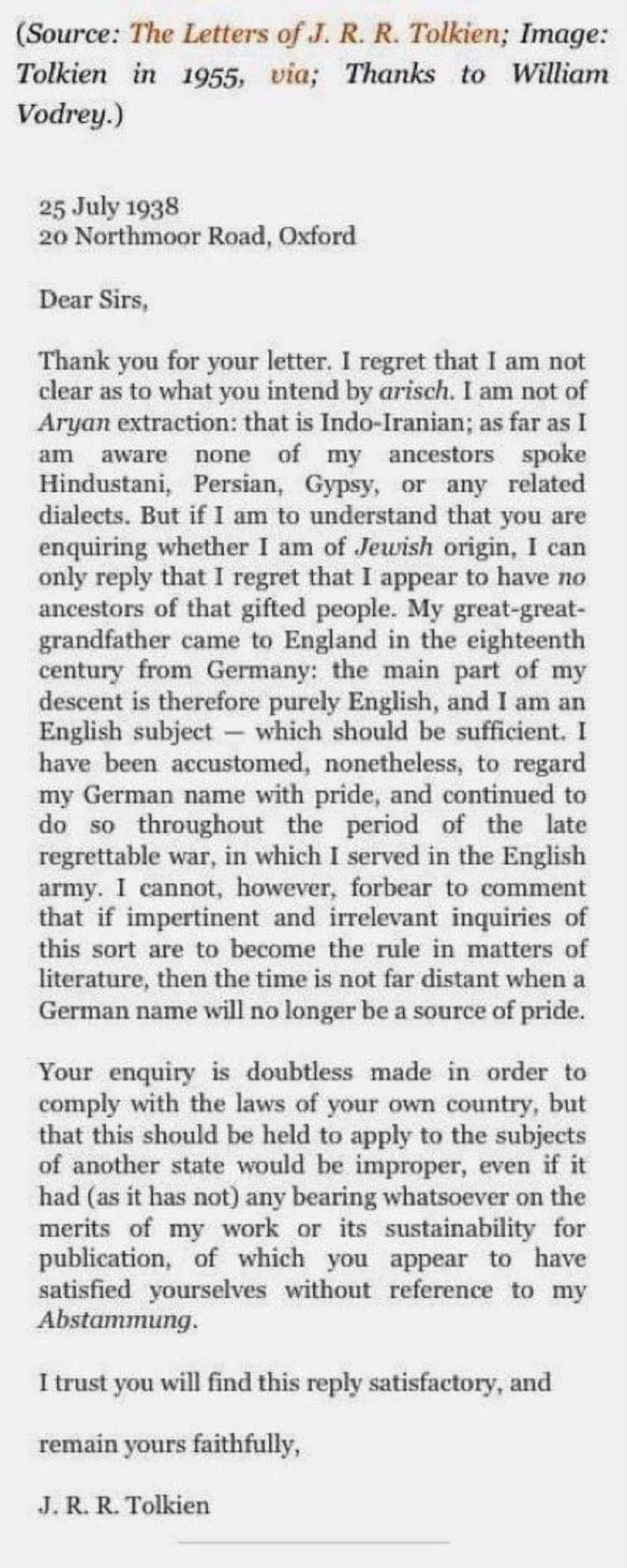
My great-great-grandfather moved to England from Germany in the eighteenth century; therefore, the majority of my ancestry is English, and I am an English subject—which should be enough. I was accustomed, however, to viewing my German name with pride, and I continued to do so during the late unfortunate war, during which I served in the English army. However, I cannot help but observe that if impertinent and useless queries of this nature become the norm in literary affairs, the moment will come when a German name will no longer be regarded as a source of pride.
Your inquiry is doubtless made to comply with the laws of your country, but that it should be held to apply to the subjects of another state would be improper, even if it had (as it does not) any bearing on the merits of my work or its suitability for publication, which you appear to have satisfied yourself without reference to my Abstammung.
I hope my response is adequate and remains yours sincerely.
J. R. R. Tolkien