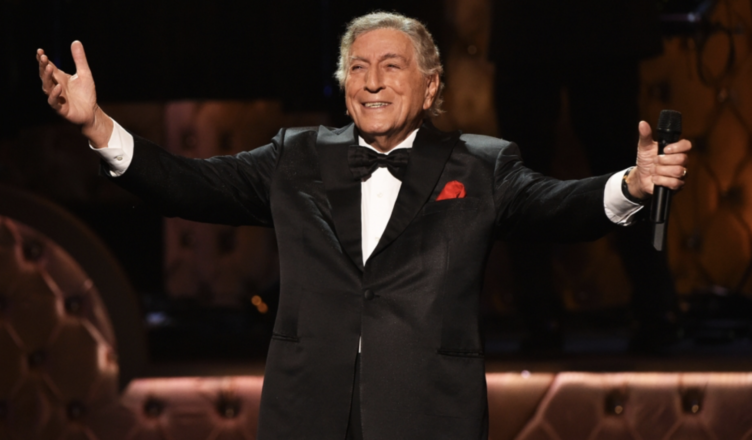
Tony Bennett, a well-known performer of American songbook classics with a more than 70-year career, passed away in his native New York at the age of 96. His spokesperson, Sylvia Weiner, informed the Associated Press that the information was accurate. In 2016, he received an Alzheimer’s Disease diagnosis.
Tony passed away today, but he was still performing at his piano the other day, and his final song was “Because of You,” his first #1 hit, according to a touching message on his social media. We will always have Tony’s music in our hearts because of you.
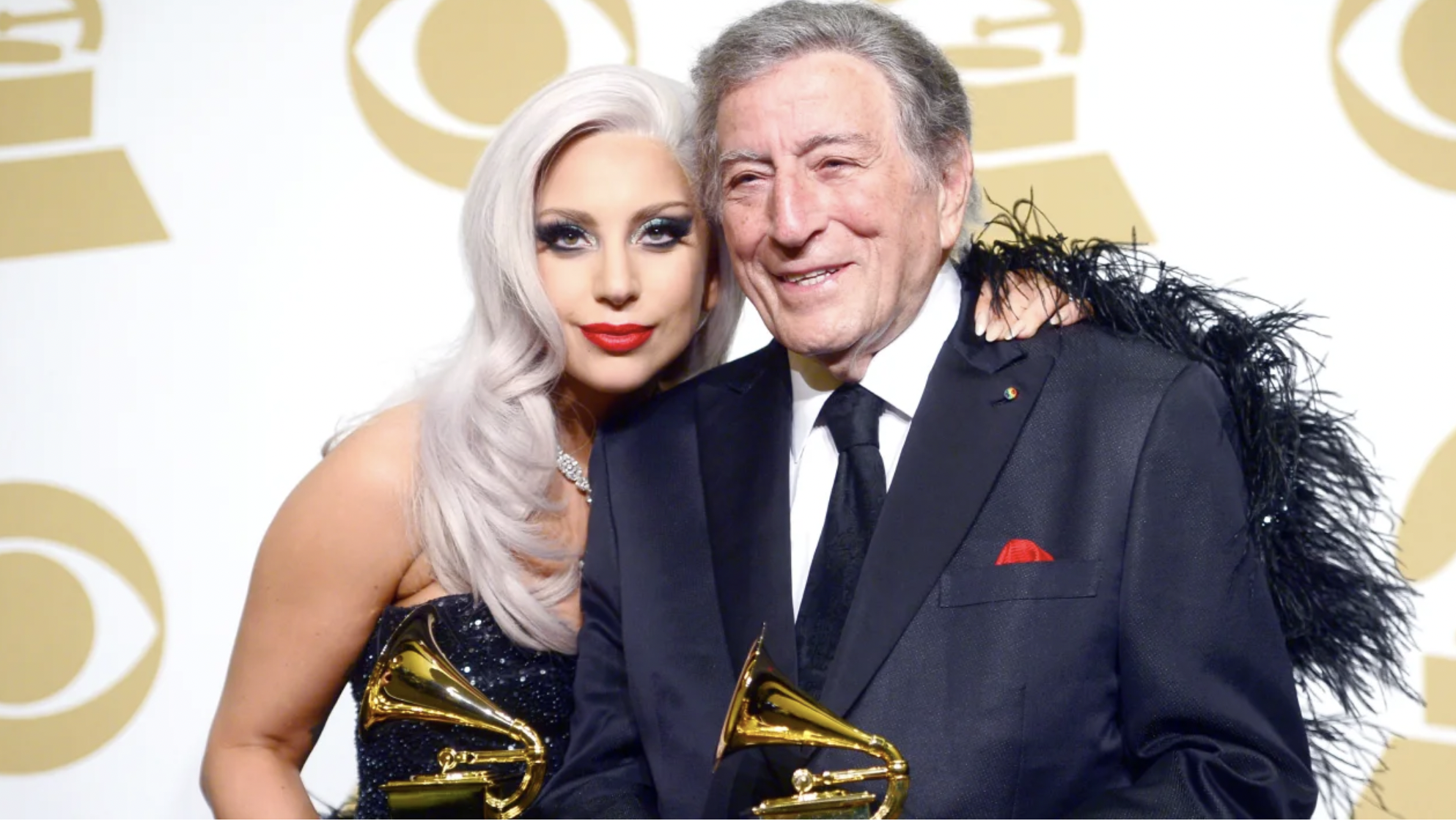
Throughout his lengthy career, Bennett received 20 Grammy Awards, starting with the Record of the Year award for “I Left My Heart in San Francisco” (1962) and including the Album of the Year award for MTV Unplugged (2004), a recording Bennett made when he was 68. He gained notoriety performing with Bob Hope’s touring show in the 1940s, and his career lasted until the early 2020s, when he worked with pop icons like Lady Gaga.
His silky, smokey voice, which began as a tenor and matured gradually with age, and his preference for songs from the Great American Songbook by George and Ira Gershwin, Rodgers and Hart, Duke Ellington, and others have remained constants throughout his extensive career.
Born in 1926, Anthony Dominick Benedetto spent his formative years in Astoria, Queens. When he was ten years old, his grocery store owner father passed away; his mother was a seamstress. The young Tony would sing at family gatherings as his entire family played guitars and mandolins. “They encouraged me,” he said to the Telegraph in 2011. “They told us, ‘Look at how Tony makes us feel good; he sings and tells jokes,’ and they gave me a passion that still exists today.”
Before enlisting as a frontline infantryman in World War II, Benedetto got his first job at age 15 as a singing waiter. Then, using the G.I. Bill, he pursued acting and music studies at the School of Industrial Art in New York. After seeing the young performer opening for Pearl Bailey in Greenwich Village, Bob Hope invited him on tour and suggested that he abbreviate his name.
The newly renamed Tony Bennett joined Columbia Records in 1950 when he was 24 years old, and a year later, his song “Because of You” reached No. 1 in the charts. Bennett sang with enormous emotion over rich strings in a manner that was influenced by Italian bel canto ballad singing, which was the dominant musical genre in postwar America before the emergence of rock and roll. He continued to record more dramatic love songs in this early-power ballad style when this sound became a trademark of his early career.
Bennett’s 1951 version of Hank Williams’ “Cold, Cold Heart” was another significant early success. Bennett initially resisted recording it, pleading with producer Mitch Miller, “Don’t make me sing cowboy songs!” Nevertheless, his version, lushly sung over strings, spent six weeks at the top of the charts. It is now regarded as the first non-novelty country song to reach mainstream radio, a significant development in both country and pop music history.
“Rags to Riches,” Bennett’s third No. 1 success, came in 1953. From then until 1959, he added four more Top 10 songs. But he was progressively going against the cultural grain. Bennett disliked rock’n’roll, not least because it rendered vocalists of his generation suddenly out of date when it arrived like many of his generation did.
He became well-known for his advocacy of the Broadway school of songwriting, which was losing popularity on the charts to rock’s more straightforward approach, which featured fewer chords and simpler lyrics. Regarding his advocacy of this music, a critic for Stereo Review stated in 1965: “He became the major discovery and creator of new composers and new songs. Tony Bennett has done more than anybody else in America to ensure that good music is heard.
The classic instance occurred in 1962, when the charts were in a slump and Bennett had gone four years without making the Billboard Top 20. Bennett sang it, scored another success, and turned it into a contemporary standard when his pianist, Ralph Sharon, played the song “I Left My Heart in San Francisco” to him. The song had been floating around for a decade without any notice. It is still regarded as his defining tune.
After “San Francisco,” Bennett returned to the Top 20 in 1963 with “I Wanna Be Around” and “The Good Life,” two songs that went on to become standards in the repertoire. His final Top 40 success would be “If I Ruled the World” from 1965. Bennett got weary of the major-label system and the less complex, more rock-oriented tunes its executives were pressuring him to record throughout the 1960s. In 1991, he remembered, “I saw it as a fiasco.” “It started to become more and more Madison Avenue programming, just a marketing thing,” the author said.
In the late 1960s, Bennett made the move to London. Bennett produced some of his best work in the 1970s, focusing more on the craft of singing and less on commercial needs, particularly two outstanding collaborations with jazz pianist Bill Evans: The Tony Bennett/Bill Evans Album (1975) and Together Again (1977).
But Bennett also experienced some personal and professional difficulties during the 1970s. After Together Again, he didn’t make another album until 1986 since he was deeply in debt and had few engagements left except for brief visits to Las Vegas. His marriage to the actress Sandra Grant was disintegrating, and he also struggled with drug addiction. Bennett overdosed on drugs in 1979; Grant accompanied him to the hospital, and they divorced in 1983.
Bennett started working on a comeback in the 1980s. His son, Danny, took over as his manager and brought back Ralph Sharon, his longtime pianist, when he met Susan Crow, who would eventually become his third wife. Bennett’s new management guided him toward theme albums like Bennett/Berlin (1987), Perfectly Frank (1992), and Steppin’ Out (1993), an album of songs originally performed by Fred Astaire, which prepared him for his 1994 MTV Unplugged appearance.
A turning point in Bennett’s career came with the release of the MTV Unplugged album, an unlikely choice for a non-rock musician. It not only became his first platinum-selling album but also broadened his appeal to adolescent MTV viewers in addition to oldies fans. Bennett became a new fixture in the mainstream music scene thanks to the album, which also received the Grammy Award for Album of the Year. He remained there until his retirement in 2021.
From then on, Bennett started to record American traditional duets with modern performers, following in the footsteps of his mentor, Frank Sinatra, in the latter stages of his career. Playin’ with My Friends: Bennett Sings the Blues, a compilation of duets with Stevie Wonder, B. B. King, Diana Krall, and other artists, was published by Bennett in 2001. The Dixie Chicks, Elton John, and Celine Dion appeared in the 2006 film Duets; five years later, Aretha Franklin, Willie Nelson, and Lady Gaga appeared in Duets II.
Bennett and Gaga struck up a special relationship and collaborated on two albums, Cheek to Cheek (2014) and Love for Sale (2021). For Gaga, the relationship went beyond just a business one; it also included her emotions. “The fact that Tony sees me as a natural-born jazz singer is still something that I haven’t gotten over,” she remarked. In August 2021, Bennett performed his final two gigs at Radio City Music Hall alongside Lady Gaga. He then announced his retirement from the stage and disclosed that he had Alzheimer’s disease.
Along with his late-career surge, Bennett also spent a significant portion of the 2000s receiving awards. Among them were the Jazz Masters Award from the National Endowment of the Arts in 2006, a Kennedy Center Honor in 2005, and a Grammy Lifetime Achievement Award in 2001.
In 1968, his idol, Sinatra, best captured him. According to Sinatra, Tony Bennett is the finest singer in the industry and the best song exponent, as he told Billboard. “When I watch him, he moves me and delights me. He is the vocalist who most accurately conveys the composer’s intentions, and perhaps a bit more. There is an underlying sensation.
Bennett leaves behind his three children, Danny, Dae, Joanna, and Antonia, as well as his third wife, Susan.